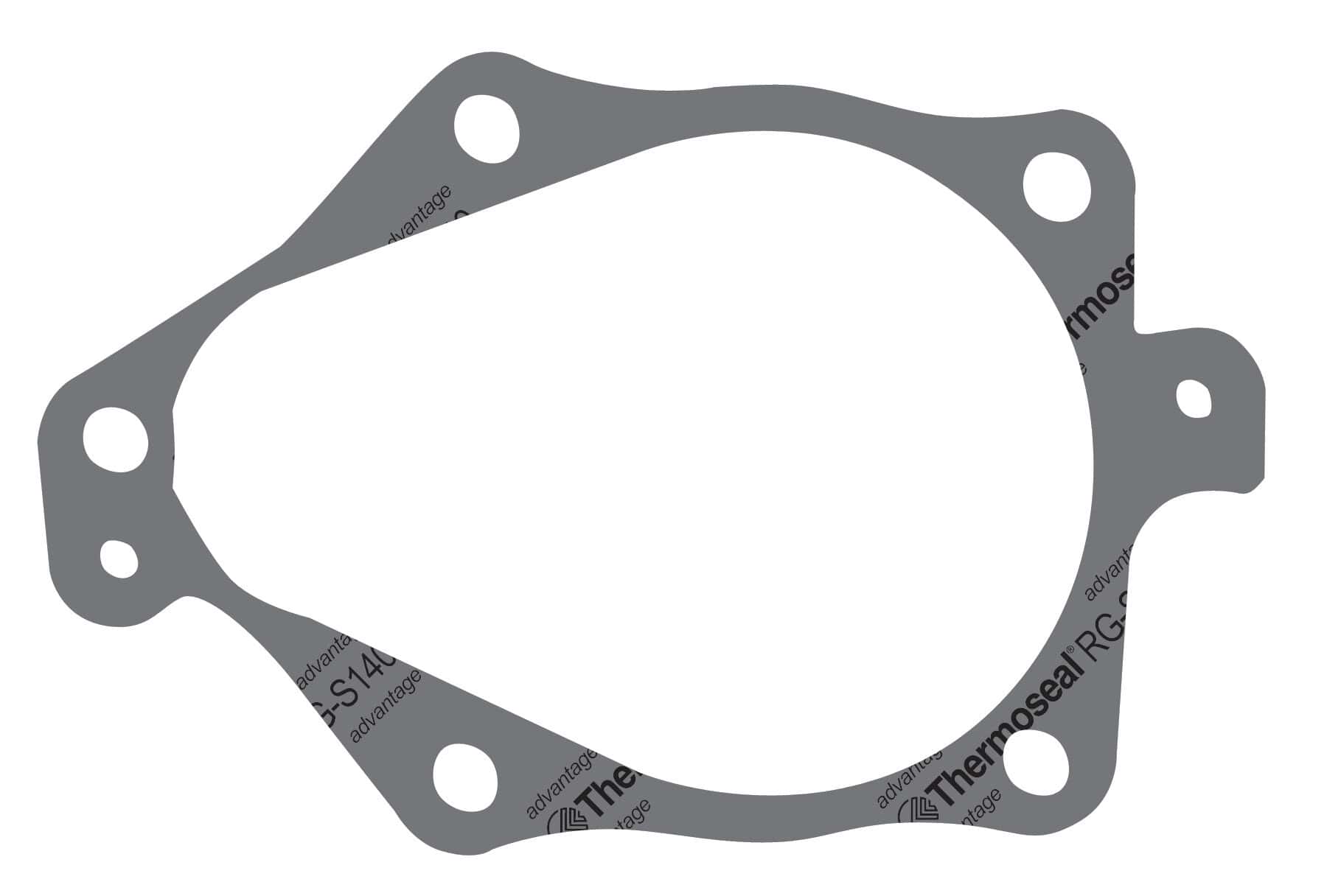
Thermoseal RG-S140
Beater Addition Rolled Goods
KLINGER Thermoseal’s Advantage Roll Goods materials perform in a wide range of applications from low-cost aftermarket to higher performing OEM seals. Continuous length rolls allow efficient and economical fabrication with high speed die-cutting equipment. When your customers want an “equivalent” or alternative to the currently specified material, there is an Advantage Roll Good for the job.
RG-S140 is a controlled-swell gasket material that provides excellent sealing where initial gasket conformability is required to compensate for flange out of flatness or roughness. After establishing initial sealability, the styrene-butadiene binder fully vulcanizes with time and heat of component operation to provide long-lasting performance. RG-S140 contains a unique blend of aramid, mineral, and cellulose fibers and mineral fillers to provide enhanced crush and temperature resistance. A factory-applied release coating on both sides aids in flange removal. Typical applications include gaskets for sealing hot oil or coolant in machinery including small engines and automotive and heavy-duty diesel engines.
RG-S140 is suitable for applications with intermittent operating temperatures up to 550°F (288°C).
Typical Values Refer to 0.031″ Thick Material Unless Noted
| Temperature maximum | 550°F (288°C) |
| Density ASTM F1315 | 87 lb/ft3 (1.4 g/cm³) |
| Compressibility ASTM F36 J | 12 – 25 % |
| Recovery ASTM F36 J | Minimum 35 % |
| Tensile strength ASTM F152 | Minimum 870 psi (9 MPa) |
| Fluid Resistance after immersion in Oil IRM903 Weight Increase Thickness Increase |
Maximum 45 % Maximum 60 % |
| Binder Type | Styrene butadiene rubber (partially vulcanized) |
| ASTM F104 Line Call Out | F729900E09M9 |
| Color | Grey |
The ability of a gasket to make and maintain a seal depends not only on the style and quality of the gasket material, but also on medium being sealed, the flange design, the amount of pressure applied to the gasket by the bolts and how the gasket is assembled onto the flanges and tightened. These factors are beyond the manufacturer’s control.